
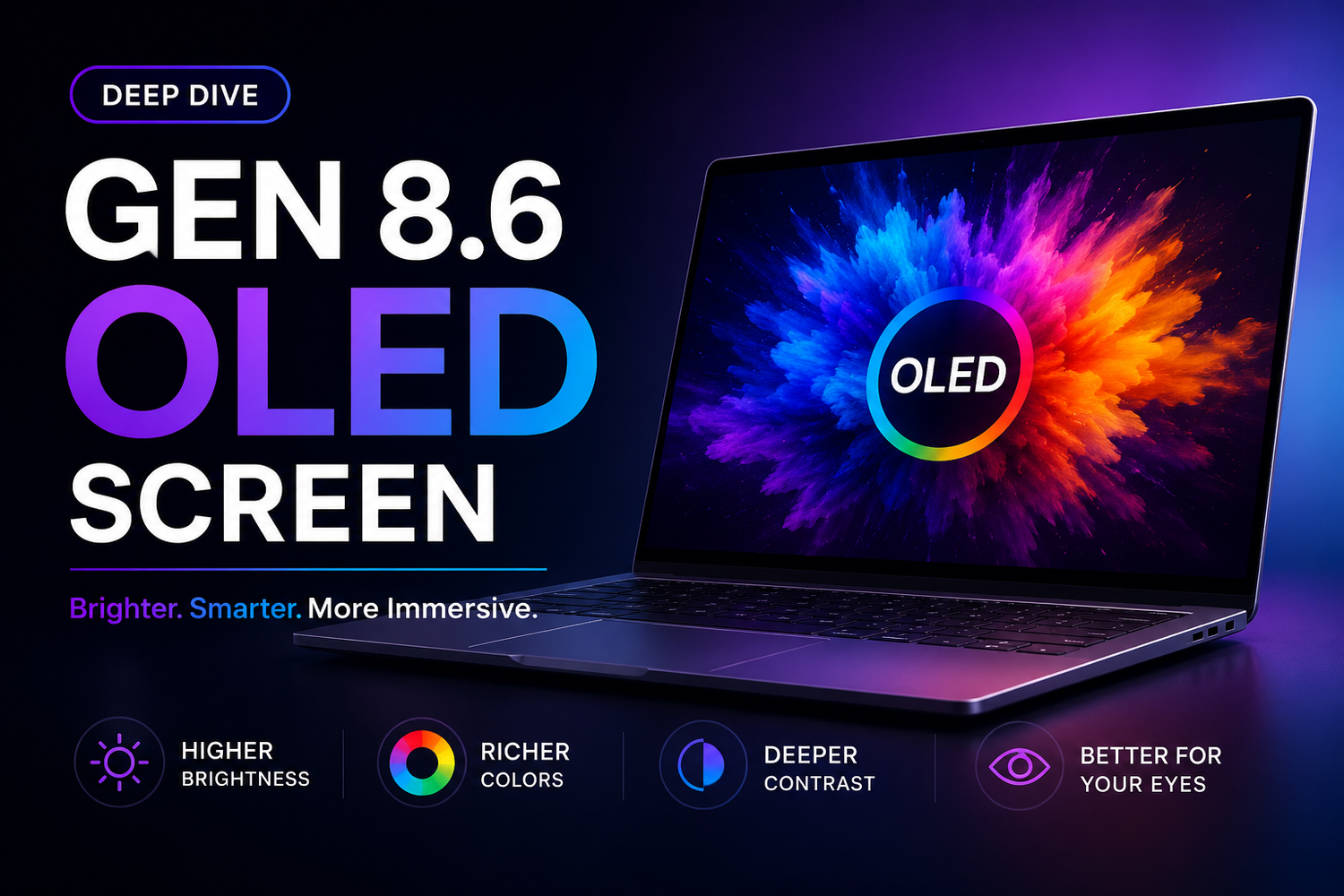
If you follow laptop displays, 2026 is the year everything changed. A new generation of OLED factories — known as Generation 8.6 (Gen 8.6) — has come online, and it is reshaping what laptop screens can do and what they cost. Here's what's happening, and what it means for anyone repairing or upgrading a laptop.
What is Gen 8.6 OLED?
Gen 8.6 represents the newest, most advanced display manufacturing standard designed specifically for IT products — laptops, tablets and mid-sized monitors. These massive factories optimise panel production by cutting larger panes of glass, driving down costs and improving brightness for premium devices.
The key is the glass itself. Gen 8.6 lines process mother-glass sheets measuring 2290mm × 2620mm — far larger than the older Gen 6 fabs that OLED laptop panels previously came from. Bigger sheets mean more 13-to-17-inch panels cut per sheet with less waste, which is exactly the size range laptops need. That efficiency is what pushes panel prices down.
The three technologies that matter
- Tandem OLED structures — vertically stacking two emission layers in series increases peak brightness and significantly extends the display's operational lifespan. This is the same approach behind the most premium tablets and laptops on the market.
- LTPO backplanes — enabling variable refresh rates from 1Hz right up to 240Hz, saving substantial battery life in portable devices while delivering ultra-smooth motion for gaming.
- Hybrid & flexible OLED — combining rigid glass with flexible thin-film encapsulation for lighter, much thinner laptop lids.
Who's building them — and who's buying
BOE officially began mass production at its B16 fab in Chengdu in June 2026 — a ¥63 billion (~$9.3 billion) investment with a designed capacity of 32,000 glass substrates per month. Its first 14-inch 2.8K panels are already shipping to more than ten customers, including Lenovo, ASUS and Acer, with laptops built on these panels expected on shelves from early 2027.
Samsung Display is running its A6 line in Asan, Korea, with yields reported above 90%. Its Gen 8.6 output — using oxide TFT and dual-stack Tandem technology — is initially dedicated to 14-inch and 16-inch panels for Apple's next-generation MacBook Pro, with around 2 million units expected in 2026 and LTPO arriving in 2027.
They won't be alone for long: Visionox and TCL CSOT have announced Gen 8.6 investments of their own — TCL CSOT's inkjet-printed (IJP) OLED approach is already appearing in flagship gaming laptops such as Lenovo's 2026 Legion R9000P with its 16-inch 240Hz panel.
Why it matters for laptop owners
Analysts expect medium and large OLED panel revenue to grow from roughly $11.5 billion in 2026 to $20 billion by 2030, driven primarily by monitors and laptops. With two high-volume Gen 8.6 lines now competing head-to-head, OLED laptop prices are widely expected to fall — meaning OLED stops being a luxury option and becomes the mainstream choice.
For repairs and replacements, it also means a new wave of OLED part numbers entering the market — panels like BOE's 14-inch 2.8K Tandem OLED family — which we track and list as they appear.
Replacing an OLED laptop screen?
TechnologyVS stocks a growing range of OLED replacement laptop screens, all Grade A and tested before dispatch, with same-day UK shipping on orders before 2:30pm. If you can't find your exact part number, contact us — new OLED panels are arriving constantly as Gen 8.6 production ramps.





Dejar un comentario
Este sitio está protegido por hCaptcha y se aplican la Política de privacidad de hCaptcha y los Términos del servicio.